Ultraviolet light — particularly in the 280–400 nm range — breaks down inks, fibers, and coatings through photodegradation, leading to fading, yellowing, and structural weakening over time. Even minimal exposure can accelerate aging. The Grail Case™ UVR Crystal Acrylic formula filters 99.9% of this radiation, ensuring your artifacts retain their original vibrancy and integrity.
Use a microfiber cloth and a pH-neutral acrylic cleaner (never alcohol or ammonia-based solutions). Apply light, circular motion. Never use paper towels or rough fabrics, which can introduce fine abrasions to the surface clarity.
Direct sunlight should always be avoided. Even with 99.9% UV filtration, the combined effects of heat and visible light can alter inks over long durations. For true archival safety, use LED lighting below 4000K and keep displays in climate-stable environments (30–50% humidity, under 75°F).
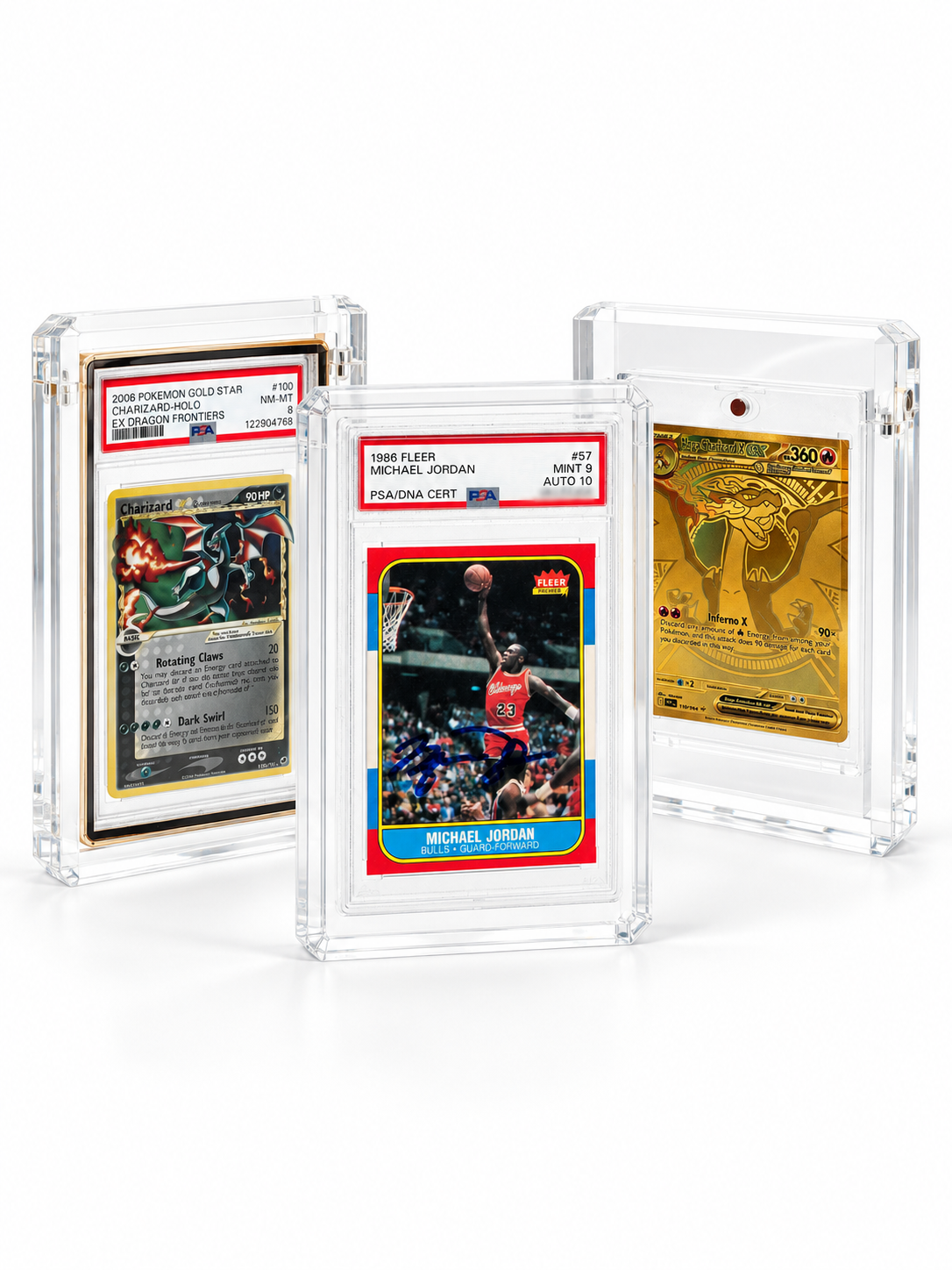
Yes — they offer limited UV resistance, but not full-spectrum protection. Over decades, even slight UV permeability compounds into visible damage. Grail Case™ serves as an additional archival barrier, creating a controlled optical environment designed for permanent display.
A proprietary 10 mm museum-grade acrylic engineered for optical clarity and archival durability. It provides 92% light transmission for visual fidelity and filters 99.9% of UV wavelengths. Each sheet is UVR-tested and certified before production to ensure compliance with archival standards equivalent to those used by major museums and conservation institutions.
Thickness isn’t aesthetic — it’s functional. At 10 mm, the acrylic achieves structural rigidity, stable refractive index, and enhanced UV filtration consistency. Thinner materials risk micro-flexion and optical distortion over time, compromising both the seal and the visual presentation.
This is why we call it The 10 Millimeter Guarantee — a standard, not a preference.
No. In fact, the opposite. The optical density of the 10 mm acrylic reduces edge diffusion and enhances color accuracy. The result is a floating, gallery-grade effect — true to life and distortion-free.
Each Grail Case™ Enclosure is designed for long-term preservation but can be safely opened and resealed using the included archival-grade fasteners. Avoid frequent handling, as repeated exposure increases environmental risk to the artifact.
Display or store in indirect lighting and controlled humidity (30–50%). Avoid proximity to heating vents or moisture sources. Like fine art, stability in temperature and light equals longevity.
Yes. Our manufacturing model guarantees a 24/7 in-stock inventory system, ensuring that preservation is never delayed by production cycles or “drops.” Collectors can select their enclosure at any time with full confidence in immediate fulfillment.
At present, Grail Case™ supports the three archival standards — PSA, Beckett and CGC/TAG. Custom projects are selectively accepted for legacy collections and institutional archives by inquiry only.
Every production batch undergoes UVR spectrophotometric testing to confirm an average filtration of ≈99.9% per batch across the 280–400 nm range. After cutting and polishing the crystal acrylic, each case can vary slightly by fractions of percentages. Some cases test at 100% UVR while some can test at 99.4% UVR.
Testing conforms to standards equivalent to ISO 9050 and ASTM G173 for UV radiation exposure.
Yes. All materials used meet or exceed conservation-grade requirements consistent with museum display and archival storage specifications. The enclosure’s formula is acid-free, chemically inert, and designed for permanent preservation of cellulose-based and polymer-encased artifacts.
Sign Up & Get 10% Off Your First Order
Join our newsletter and get exclusive access to giveaways, discounts, and new releases.
We respect your privacy. Unsubscribe anytime.


